
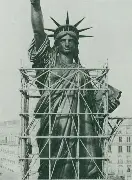
The Statue of Liberty, formally known as Liberty Enlightening the World, is one of the most recognizable icons of the United States. Standing over 305 feet tall (93 meters) on Liberty Island in New York Harbor, she is a colossal figure made of copper sheets draped over an internal framework of iron and steel.
A Gift of Friendship and Freedom
The idea for the statue originated in France with historian and abolitionist Édouard de Laboulaye in 1865. It was intended as a gift from the people of France to the United States to commemorate the centennial of American independence and, crucially, to celebrate the abolition of slavery following the American Civil War.
The statue was designed by sculptor Frédéric Auguste Bartholdi. Its internal, flexible steel skeleton—an engineering marvel designed by Alexandre-Gustave Eiffel (the man behind the Eiffel Tower)—allowed the copper skin to withstand the intense winds of the harbor.
Symbolism and Meaning
Lady Liberty is laden with symbolism:
- The Torch: Represents enlightenment, lighting the path to liberty.
- The Tablet: Held in her left hand, it is inscribed with the date of the U.S. Declaration of Independence in Roman numerals: JULY IV MDCCLXXVI (July 4, 1776).
- The Crown: Features seven spikes that represent the seven continents and seven oceans of the world, signifying the universal concept of liberty.
- The Broken Shackles: At her feet, largely unseen by visitors, lie broken shackles and chains, a direct and powerful representation of the breaking of the chains of oppression and tyranny, particularly slavery.
Construction, Journey, and Legacy
The copper statue was completed in France in 1884, then disassembled into 350 individual pieces and shipped across the Atlantic. It was reassembled on its American-built pedestal and officially dedicated on October 28, 1886.
As millions of immigrants arrived by ship to the nearby processing center at Ellis Island in the late 19th and early 20th centuries, the Statue of Liberty became the first, powerful glimpse of America. She swiftly earned the nickname the “Mother of Exiles,” transitioning from a monument celebrating a revolution to a lasting symbol of hope, refuge, and opportunity for people around the globe.